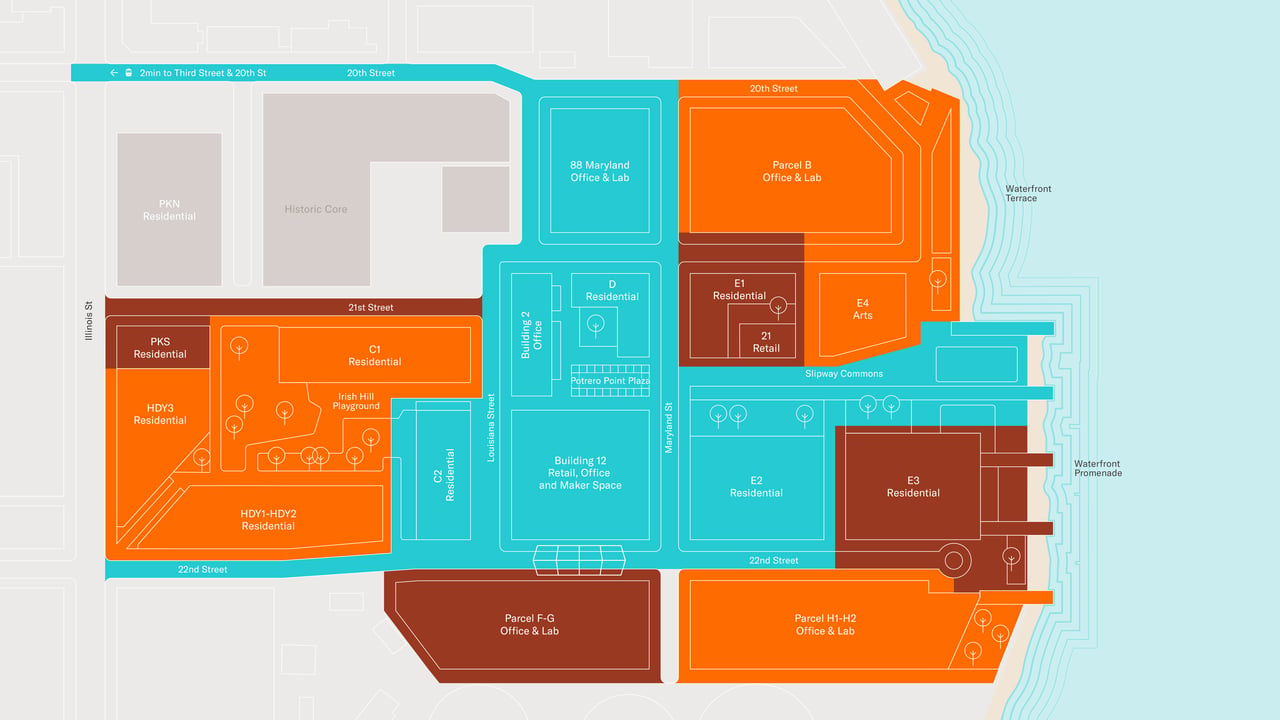
Pier 70 Redevelopment: What's Happening at San Francisco's $3.5 Billion Waterfront Project
Quick answer: Pier 70 is a 35-acre former WWII shipbuilding site on San Francisco's central waterfront, between Illinois Street, 20th Street, the Bay, and the former PG&E Potrero Power Plant. Developer Brookfield Properties, working with the Port of San Francisco, is turning it into a mixed-use community with up to 2,000 new homes (30% below-market-rate), up to 1.8 million square feet of office, lab, and R&D space, nine acres of new public open space, and 250,000 square feet of rehabilitated historic buildings. The project is expected to cost more than $3.5 billion total; roughly $230 million has already been spent on the first phase, which includes the newly opened RH restaurant and gallery, Building 12's Maker Hall, and Crane Cove Park.
There's a monster redevelopment project going on at San Francisco's Pier 70 that's completely transforming this former industrial shipbuilding site into a massive mixed-use space — thousands of new homes, acres of open parks and rec space, waterfront promenades, creative space, and some absolutely stunning amenities right on the edge of San Francisco's central waterfront.
I'm Austin Klar, a lawyer turned real estate agent in San Francisco and Marin County. Developers are spending over $3 billion and have been working for nearly two decades to turn this abandoned WWII shipbuilding hub into a state-of-the-art, environmentally sustainable community built to withstand sea level rise and bring thousands of new residents and workers to the area over the coming years.
In this post, I'm breaking down everything going on at Pier 70 — what's already open in Phase 1, how the City is converting it into one of the biggest developments in the Central Waterfront's history, and what to expect as the project continues.
Where Is Pier 70?
The 35-acre development site is bound by Illinois Street to the west, 20th Street to the north, the San Francisco Bay to the east, and the former PG&E Potrero Power Plant to the south.
Interestingly, that Potrero Power site is home to its own mega-development — developer Associate Capital is converting the defunct PG&E power plant into a brand-new community that keeps the power stack as a historic anchor for parks, retail, restaurants, lab space, and thousands more homes.
In addition to 15-plus development pads that will hold a mix of housing, offices, and retail, Pier 70 includes three historic buildings and a network of public open spaces, new streets, and pedestrian facilities — plus a significant amount of creative-use space, including 90,000 square feet dedicated specifically to non-profit arts organizations. The vision for the site is to function as an extension of the neighboring Dogpatch neighborhood, which has its own diverse creative and industrial history that ties directly into the mix of uses historically found at Pier 70.
The Site's Industrial History
Pier 70 sits within Potrero Point on San Francisco's eastern waterfront, which was the most important center of western U.S. heavy industry for over a century. The area was prime for industrial operations because land was cheap, it had deep-water access ideal for large ships, and it was isolated from the more populated parts of what was then a fast-growing city.
Over half a dozen major manufacturing and utility companies — railways, iron works, shipbuilders — operated here and were significant contributors to the local economy, the military, and the labor force. One of their old office buildings has since been converted into what I think is the single most beautiful retail and hospitality space in the entire city — more on that below.
Who's Behind the Project
The City took ownership of the site in the 1980s, and planning and community outreach began in the early 2000s for a new waterfront community that would honor the site's legacy — restoring historic buildings, revitalizing shipyard land with modern activity, creating a brand-new publicly accessible shoreline, and continuing ship repair operations at portions of the site.
To make it happen, the City had to create an entirely new zoning district, and the project wasn't formally approved until 2017. Since then, construction has been off and on. The initial timeline called for a 15-year buildout, led at the start by developer BAE, later acquired by Brookfield Properties — the firm behind some of the largest developments in the city, including the redevelopment of San Francisco's west side at Stonestown Galleria. COVID put a major wrench in the original timeline, halting construction entirely at one point while the project's future hung in the balance. Construction and leasing have since resumed, and there's real momentum again.
What's Planned for Pier 70
● Housing: The precise unit count isn't finalized, as individual housing complexes are still working through planning, but the project is approved for up to 2,000 new homes, 30% of which will be below-market-rate.
● Retail and services: Ground-floor retail and service businesses will line the waterfront park, concentrated densely along Maryland Street between 21st and 22nd, and along Slipway Commons.
● Open space: Nine acres of new public open space will abut the waterfront and run throughout the park, including a continuous waterfront park along the shoreline that extends the Bay Trail from north to south, connecting into the many miles of bay trail that run down the SF waterfront. This part of the city also gets some of the best weather around — sheltered from the Pacific's cold fronts and generally less windy, making it a great spot to actually spend time outside.
● Event space: A new 25,000-square-foot event plaza is planned that can accommodate large-scale events, light shows, art festivals, farmers markets, and exhibitions.
● Office, lab, and R&D: Approved plans call for up to 1.8 million square feet of new office, lab, and R&D space, plus 250,000 square feet of historic buildings to be rehabilitated, along with hundreds of thousands more square feet for manufacturing, retail, and other uses.
How the Project Is Handling Sea Level Rise
The entire development is being raised more than five feet above the maximum estimated sea level rise projected to occur over the next century. New buildings are being built nearly six feet off the ground, and all the park space along the shoreline is being terraced to serve as a buffer and drainage system for the site. It's a genuinely well-studied approach from both the City and the developer.
What's Already Open at Pier 70
This isn't all theoretical — it's actually happening. Several buildings at the site are already open.
RH San Francisco
RH, formerly known as Restoration Hardware, took over the old Bethlehem Steel building and turned it into a spectacular restaurant and retail space. The restaurant, called the Palm Court, sits on the ground level, with multiple wine bars throughout — you can order a glass and roam the 80,000-square-foot gallery, taking in the design and finishes as you go. There are also two rooftop spaces with incredible views of the Bay Bridge, the East Bay, Chase Center, and all the development happening at Pier 70 and the Potrero Power Station.
Building 12
Building 12 was originally built in 1941 as a site for cutting and forming steel plates for ship hulls. Architecture firm Perkins & Will has reimagined the space as a three-floor mixed-use building with 70,000 square feet of office space and over 70,000 square feet of retail, including what's being called a Maker Hall, where designers and craftspeople can open shops and flexible creative spaces to showcase their work. Several companies have already relocated or plan to relocate there, including padel and pickleball facility Bay Padel, renowned bakery Bread Belly, and Standard Deviant brewery.
The developer and the Port have spent over $230 million on this first phase alone, and the entire development is expected to cost more than $3.5 billion. The original 15-year buildout timeline definitely isn't going to hold, but it's genuinely encouraging to see real progress being made on the ground.
Why This Corner of the Waterfront Is About to Get a Lot More Interesting
Pier 70 is going to be especially compelling because it won't be isolated the way it once was — it's one of a string of new mixed-use communities being developed along San Francisco's waterfront. Mission Rock is being developed just to the north, already underway with its first phase nearly complete. Chase Center, home of the Golden State Warriors, and the 11-acre restaurant and bar district supporting it, Thrive City, sit just north as well. And the new community planned for the Potrero Power site is immediately to the south.
On top of that, Pier 70 is walking distance to Dogpatch and a short drive to Potrero Hill, SoMa, the Financial District, and plenty of other San Francisco neighborhoods.
If you're thinking about buying in the area and have questions about the market or how all of this development is likely to impact the local real estate landscape, I'm happy to help. I moved to the Bay Area over a decade ago to work as a lawyer at one of the largest law firms in the world, and I've since helped people relocate to San Francisco from all over the country. Reach out any time, no pressure, no obligation.
Frequently Asked Questions
What is Pier 70 in San Francisco?
Pier 70 is a 35-acre former WWII shipbuilding site on San Francisco's central waterfront, being redeveloped by Brookfield Properties and the Port of San Francisco into a mixed-use community with new housing, office and lab space, retail, and public parkland.
How much housing is planned at Pier 70?
The project is approved for up to 2,000 new homes, with 30% designated as below-market-rate. The exact unit mix and count are still being finalized as individual housing complexes move through the planning process.
What's already open at Pier 70?
RH San Francisco's Palm Court restaurant and gallery, Building 12's office and retail space (including Bay Padel, Bread Belly, and Standard Deviant brewery), and Crane Cove Park are all open and operating today.
How is Pier 70 addressing sea level rise?
The entire development is being raised more than five feet above the maximum projected sea level rise over the next century, with new buildings built nearly six feet off the ground and terraced shoreline parks designed to serve as a buffer and drainage system.
How much will the Pier 70 development cost?
The full build-out is expected to cost more than $3.5 billion. The developer and the Port have already spent over $230 million on the first phase alone.
When will Pier 70 be finished?
The original timeline called for a 15-year buildout following formal approval in 2017, but COVID significantly delayed construction. That original timeline is no longer realistic, though construction and leasing have resumed and progress is ongoing.
I'll be covering the other major waterfront projects near Pier 70 — Mission Rock, the Potrero Power Station redevelopment, and more — in future posts, so check back if you want to stay on top of everything happening along San Francisco's central waterfront. And if you're evaluating a purchase near any of these developments, I'm happy to walk through how the timeline and buildout are likely to affect value in the surrounding neighborhoods.