Where Are South Beach and Yerba Buena Located?
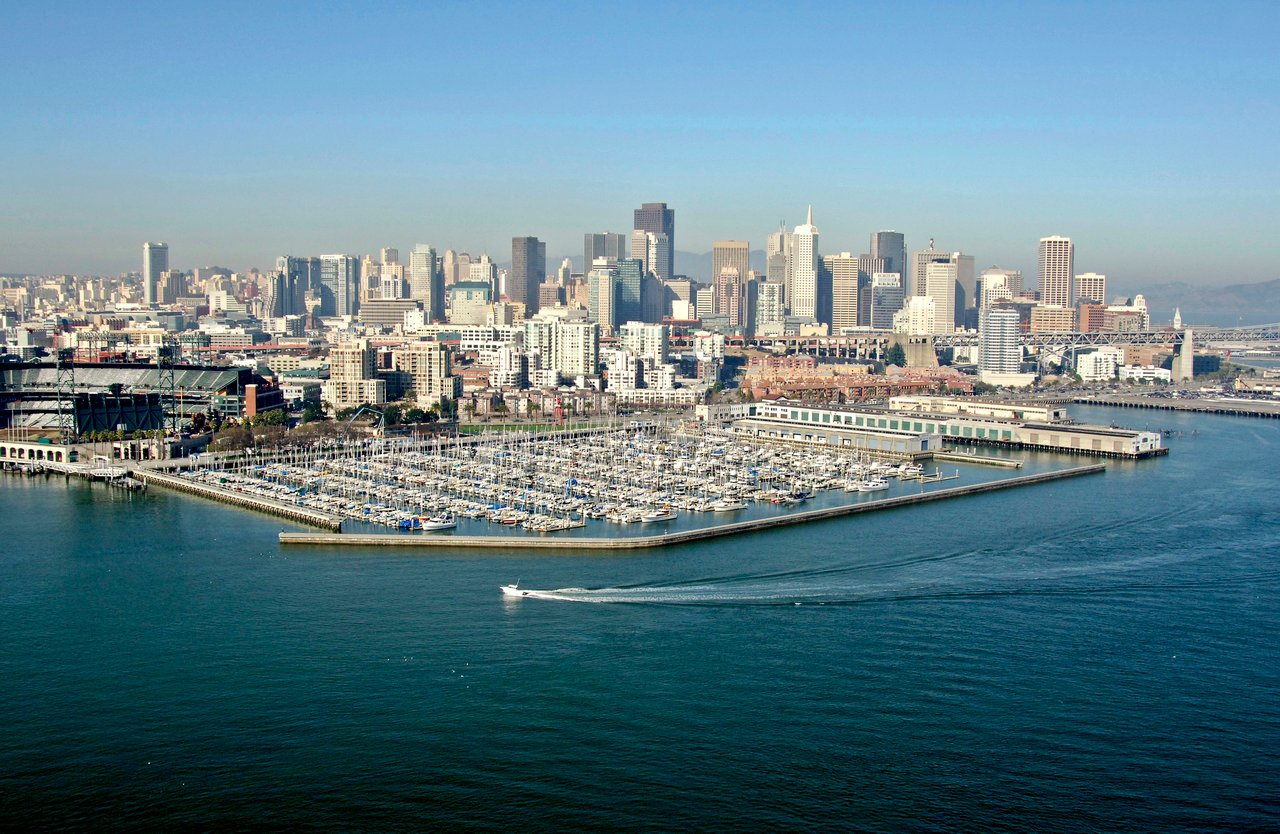
South Beach and Yerba Buena sit south of Market Street and east of SoMa, hugging the eastern waterfront along the Embarcadero. Together they form the most contemporary, vertical, amenity-rich stretch of residential real estate in the city — a bridge between the Financial District to the north and the rapidly growing Mission Bay to the south.
Because they sit on the east side of the city, these neighborhoods get better weather than most of San Francisco. Fog and cold fronts come in off the Pacific from the west, and these neighborhoods are largely protected from it. The land is relatively flat and built largely on fill, which combined with the favorable microclimate makes for an extraordinarily walkable daily living experience.
Most of the housing stock here was built in the 1990s, 2000s, and 2010s as part of a major downtown redevelopment push — glass-clad high-rises packed with amenities like pools, gyms, concierge service, rooftop decks, and movie theaters, all designed for urban professionals who want views, walkability, and proximity to work. There are also midrise lofts and adaptive reuse buildings, including brick-and-timber warehouse conversions in South Beach, some of the most architecturally interesting residential spaces in the city.
These neighborhoods sit steps from Salesforce Tower, the Transbay Transit Center, UCSF Mission Bay, Chase Center, Thrive City, and Oracle Park, and are walking distance to the Financial District, Moscone Center, and the Ferry Building, with CalTrain, BART, and Muni all close by. On paper, it's the perfect urban living environment — and it was, until 2020.
How Strong Was This Market Before the Pandemic?
To understand how significant this recovery is, it helps to know how far these neighborhoods fell. In Q3 2017, the condo market in Yerba Buena and South Beach was in essentially neutral territory, with monthly supply — the relationship between available inventory and buyer demand — sitting at about 4.3 months. Neutral is right around four months: not a buyer's market, not a seller's market, just a healthy, functioning market.
Average price per square foot was $1,242, homes were taking about 46 days to sell, and they were selling at roughly asking price. The market stayed balanced through 2018 and 2019. A flood of new inventory from buildings like 181 Fremont, the Avery, and MIRA softened supply, but prices held steady thanks to strong demand, finishing 2019 at about $1,272 per square foot. Then came 2020.
Why Did South Beach and Yerba Buena Collapse During the Pandemic?
When the pandemic hit, the condo market in these two neighborhoods collapsed more severely than almost anywhere else in San Francisco, for a specific reason: everything that made them desirable vanished almost overnight. Proximity to work meant little when offices went empty. Walkability to restaurants meant little when restaurants closed. The urban energy and amenity-rich lifestyle evaporated, leaving a dense, vertical condo environment with no foot traffic, rising crime and homelessness, and nothing open.
Meanwhile, remote work meant buyers wanted backyards, home offices, and cheaper cost of living instead of proximity to a downtown office. Everything these condos couldn't offer, the suburbs could, so the flight accelerated and inventory piled up.
● Absorption rate: the share of available homes actually selling fell to about 9.5% by mid-2020 — less than one in ten condos on the market found a buyer.
● Monthly supply: shot up to 10.5 months by Q3 2020, as active listings tripled while sales collapsed.
● Days on market: climbed from the mid-40s into the 50s, 60s, and eventually 70s.
● Price declines: values dropped 15-30% depending on the building. Some condos sold in 2022 and 2023 for less than they had in 2015, 2016, or 2017 — in some cases, less than in 2010, wiping out a decade of appreciation while owners kept paying HOAs, property taxes, and insurance.
The Federal Reserve's rapid rate-hiking campaign starting in 2022 made things worse, layering rising borrowing costs, HOA dues, and insurance premiums onto a neighborhood that had already lost its appeal and was drowning in unsold inventory. 2022 and 2023 were the worst years this sub-market has ever seen.
Why Are South Beach and Yerba Buena Surging Now?
The driver behind the current recovery is the AI industry and its extraordinary concentration of office leasing within blocks of these two neighborhoods.
As of Q2 2026, San Francisco's office vacancy rate has dropped to approximately 29.7%, down from a peak of 36.9% in Q3 2024 — a decline of more than 7 percentage points in under two years. San Francisco led the nation in year-over-year office vacancy improvement, with a 5-percentage-point drop in the most recent 12-month period, the largest improvement of any major U.S. market.
But the more important number isn't the overall vacancy rate — it's where the demand is concentrated. This isn't a broad-based recovery across every submarket; it has a very specific geography that maps almost exactly onto South Beach and Yerba Buena.
● AI net absorption: AI companies contributed nearly 1 million square feet of net office absorption in Q2 2026 alone, with a year-to-date total of 3.2 million square feet — the highest YTD total on record.
● Share of leasing activity: as of Q1 2026, AI companies accounted for 30% of all San Francisco leasing activity since 2023, and more than 75% of the market's total net absorption.
● Submarket concentration: the South Financial District and Mission Bay/China Basin captured the most growth, and Yerba Buena registered meaningful occupancy growth for the first time in years, driven by spillover demand from those core AI submarkets.
Anthropic, which recently crossed one million square feet of office space in San Francisco, has built its footprint almost entirely on Howard Street in SoMa, currently occupying space at 500 Howard, 505 Howard, 342 Howard, and 400 Howard. In January 2026, it signed a lease for the entire 25-story tower at 300 Howard Street — 420,000 square feet — which it plans to move into in 2027 as its expanded headquarters. That building sits two blocks from Yerba Buena, adjacent to Salesforce Park and the Transbay Transit Center. This stretch of Howard Street, now branded "AI Alley" by landlords and brokers, is the most valuable commercial corridor in the city.
OpenAI crossed one million square feet in San Francisco this spring as well, with its footprint concentrated in Mission Bay — the neighborhood directly south of South Beach — across leases at 1455 Third Street, 1515 Third Street, 550 Terry Francois Boulevard, and, most recently, the former Dropbox headquarters at 1800 Owens Street, where it signed a sublease for approximately 280,000 square feet in early 2026.
So Anthropic sits two blocks north of Yerba Buena, and OpenAI sits a few blocks south in Mission Bay, directly adjacent to South Beach — putting these two residential neighborhoods squarely between two of the most valuable AI company footprints in the world. And it's not just those two companies: CBRE reports 53 AI companies currently searching for office space in San Francisco, representing 3.1 million square feet of demand, with AI companies now accounting for 62% of total tech tenant demand in the city, the highest share of any major U.S. market. San Francisco is expected to see nearly 13 million square feet of total office leasing activity in 2026, a 15% year-over-year increase and the most of any major U.S. metro.
Retail is following a similar trajectory. Vacancy in the city's prime commercial corridors fell to 6.5% in 2025 and continues to decline, though vacancy in areas like Union Square remains elevated at around 23%. A $25 million Downtown Business Fund launched by the Lurie administration in April 2026 is now actively subsidizing new restaurant and retail openings near Union Square and Moscone — the heart of the Yerba Buena district.
Put simply: tens of thousands of high-income AI workers are going to need somewhere to live, and the residential neighborhoods closest to where they work are feeling that demand directly. Higher demand without a matching increase in supply means higher prices — and that's exactly what's happening.
What Is This Doing to Home Prices in South Beach and Yerba Buena?
The shift from the pandemic-era numbers has been dramatic. New listings are down 5% so far this year, while closed sales are up almost 16% — inventory is falling instead of climbing.
● Average price per square foot: up 9% so far this year compared to the same period last year.
● Average sale price: up 10.3% over that time period.
● Median sale price: up 24.4% over that time period.
● Days on market: down 29%, back into the low 40s.
● Monthly supply: down almost 30% year over year to 2.9 months, trending into seller's-market territory for the first time in the better part of a decade.
● Absorption rate: up 41.4% compared to a year ago.
The anecdotal evidence backs up the data. The Avery has had its best year on record so far, including multiple penthouse sales north of $9 million. One Steuart Lane, after several sluggish years, has closed more than $28 million in sales in less than two months. Even Millennium Tower is showing signs of recovery — a unit I comped for a client two years ago at $2.9 million is now valued at roughly $3.4 million.
On the ground, I recently closed a three-level, three-bedroom condo with a wraparound rooftop terrace for a buyer client — it received multiple offers within about a week and a half and sold over ask, nearly double what the seller paid roughly 12 years earlier. That same unit had been on the market for half a million dollars less just two years ago and couldn't find a buyer. I also listed a condo in the area this year that had failed to sell with another agent back in 2024; after prepping it, we received multiple offers within two days on the market and sold it over ask, for more than the original owners paid the developer a decade ago.
Why Are Rising Rents Pushing More Buyers Into These Neighborhoods?
Rising rents are compounding the demand. San Francisco has the fastest-growing rents in the nation and is now more expensive to rent in than New York City. Because condos aren't subject to rent control, renters in these high-end buildings are increasingly choosing to buy rather than absorb ongoing cost-of-living increases that a fixed-rate mortgage would lock in instead. One buyer who made an offer on a condo I listed had just been notified of a rent increase of more than $1,000 a month — a meaningful enough number to push someone from renting into buying.
With no new condo buildings coming to market the way they did in 2018, 2019, and 2020, there isn't the same flood of new inventory that pressured prices down in the past. Pricing is expected to keep recovering, and it's plausible we see South Beach and Yerba Buena surpass their pre-pandemic peaks before long.
Frequently Asked Questions About South Beach and Yerba Buena
Why did South Beach and Yerba Buena decline so much during the pandemic?
These neighborhoods depend heavily on proximity to downtown offices, restaurants, and urban amenities. When offices emptied out and remote work took hold, everything that made them desirable disappeared almost overnight, and condo values fell 15-30% depending on the building.
What's driving the recovery in South Beach and Yerba Buena?
AI companies, led by Anthropic and OpenAI, have leased millions of square feet of office space within a few blocks of these neighborhoods, driving down San Francisco's office vacancy rate and creating strong residential demand from a growing base of high-income tech workers.
Is South Beach or Yerba Buena a buyer's or seller's market right now?
Monthly supply has fallen to about 2.9 months so far this year, trending toward seller's-market territory for the first time in nearly a decade, though it hasn't fully tipped there yet.
Have home prices recovered to pre-pandemic levels in these neighborhoods?
Not yet, but they're closing the gap quickly. Median sale prices are up 24.4% year over year so far in 2026, and with limited new inventory coming to market, prices are expected to continue climbing toward — and potentially past — pre-pandemic peaks.
Where are Anthropic and OpenAI's offices relative to South Beach and Yerba Buena?
Anthropic's footprint is concentrated on Howard Street in SoMa, about two blocks north of Yerba Buena, including its new 420,000-square-foot lease at 300 Howard Street. OpenAI's footprint is concentrated in Mission Bay, directly south of South Beach.
If you're thinking about selling a condo in Yerba Buena or South Beach — or anywhere else in the city — valuations you received even six to twelve months ago are likely out of date given how quickly this market is moving. I was a lawyer at one of the biggest law firms in the world before getting into real estate, and I've lived in San Francisco for over 13 years, including several years in South Beach myself. I've watched this sub-market collapse and watched it begin its comeback, and I'm happy to give you an honest, current picture of what the opportunity looks like for you. Reach out anytime.