Where Did the Name "Nob Hill" Come From?
Before the 1850s, this neighborhood wasn't called Nob Hill at all. It was known as California Hill, named for California Street, which runs straight up and over it on its way from the Embarcadero toward the Pacific Ocean.
As San Francisco boomed during and after the Gold Rush, California Hill turned out to be some of the most desirable real estate in the city. It sat close to the center of everything being built downtown, but high enough above the noise and waterfront chaos to feel like its own world.
In the 1870s and 1880s, four of the most powerful men in the American West built their mansions at the top of the hill: Leland Stanford, Mark Hopkins, Charles Crocker, and Collis Huntington, known collectively as the Big Four. They'd made their fortunes as Sacramento merchants during the Gold Rush, then joined together to found the Central Pacific Railroad, which built the western half of the first transcontinental railroad. When that railroad connected to the rest of the country in 1869, their wealth became essentially unlimited.
Silver baron James Flood built here too, along with a handful of other newly minted millionaires. The style of wealth on display was so showy that people started calling the hill's residents "nabobs," a term borrowed from the British for a flashy, powerful man who'd made his fortune overseas. Nabob got shortened to "nob," and by around 1876, newspapers were calling it Nob Hill.
The grade on the south face of the hill is brutally steep, close to 25 percent in spots, which was too much for horses and carriages. So the wealthy residents funded their own solution: Leland Stanford personally financed the California Street Cable Railroad, which opened in 1878. It's still running today and is the oldest continuously operating cable car line in the city.
How Did the 1906 Earthquake Change Nob Hill?
On April 18, 1906, the earthquake and the fires that followed leveled almost the entire hill. Every one of the Big Four mansions burned to the ground. The only structure that survived was James Flood's brownstone mansion, because brownstone doesn't burn the way wood does — that building still stands today.
What's most interesting about Nob Hill's history is what happened next. Instead of fading into memory, the neighborhood rebuilt itself almost immediately into something even more iconic. Grand hotels rose directly on top of the old mansion lots:
● The Fairmont: had just been completed right before the earthquake, was gutted, and was rebuilt.
● The Mark Hopkins Hotel: went up in 1925 on the site of Hopkins' old mansion.
● The Huntington Hotel: opened as apartments in 1922 and converted to a hotel in 1924, sitting across from Huntington Park, which Collis Huntington's widow Arabella donated to the city in 1915.
● Grace Cathedral: modeled loosely after Notre Dame in Paris, went up over decades on the site of the old Crocker mansion, finally finishing construction in 1964.
This is a neighborhood that's been reinventing itself on the same footprint for a century and a half — from mansions, to ashes, to some of the grandest hotels in the American West. That history, combined with the architecture and easy access to so much of what makes living in San Francisco great, is a huge part of why Nob Hill still commands the prestige it does today.
Where Is Nob Hill Located in San Francisco?
Nob Hill sits roughly bound by Van Ness Avenue to the west, Broadway to the north, Bush Street to the south, and Stockton Street to the east. Different sources draw the lines slightly differently, but that's the general footprint.
What matters more than the exact boundary is where it puts you: walking distance to the Financial District, Union Square, Chinatown, Russian Hill, Pacific Heights, and Japantown. That location is exactly why the railroad barons picked this hill in the first place — close enough to the center of commerce to run their empires, high enough above it to escape the noise. That's still true today.
Nob Hill has a Walk Score of 99, making it one of the most walkable neighborhoods in the entire city, and it's genuinely one of the only residential neighborhoods in San Francisco where you can live a five, ten, or fifteen minute walk from a Financial District job and still come home to a quiet, tree-lined, architecturally stunning street. For anyone who wants an easy commute downtown without actually living in the Financial District or SoMa, this is about as good as it gets.
What Is Transit Like in Nob Hill?
San Francisco has only three cable car lines left in the entire system, and all three run directly through Nob Hill. The California Street line crests at the top of the hill and connects down into the Financial District and Chinatown on one end, and out toward Van Ness on the other.
The Powell-Mason and Powell-Hyde lines both start near Union Square, climb up, and actually cross the California line at the very summit of Nob Hill, right at Powell and California — the only spot in the entire cable car system where the lines cross each other. From there, those two lines continue on toward Russian Hill, North Beach, and Fisherman's Wharf.
On top of the cable cars, a full network of Muni bus lines runs through the neighborhood, including the 1-California — one of the more heavily used commuter lines in the city — along with the 27, the 19, and the 12, connecting Nob Hill straight into downtown, South of Market, and North Beach without needing a car at all. Between the walkability and the transit, this is one of the few neighborhoods in San Francisco where I'd tell a client they genuinely don't need a car if they work downtown.
What Is the Lifestyle Like in Nob Hill?
If Nob Hill's convenience is what makes it practical, its amenities are what make it distinct. The lifestyle here is built around hospitality — the most luxurious hotels in San Francisco, along with their bars, restaurants, and events.
The Fairmont Hotel anchors the top of the hill, one of the most photographed hotel exteriors in the city, and its Tonga Room tiki bar and holiday gingerbread house have been local institutions for decades. Right across the street is the Mark Hopkins, home to the Top of the Mark, a cocktail lounge on the top floor with panoramic Bay views that's been a San Francisco tradition since around 1940.
The Huntington Hotel and its iconic Big Four restaurant recently reopened after a multi-year shutdown and major renovation. The Big Four originally opened in 1976, named after the same four railroad tycoons behind the neighborhood's founding, and for decades it was one of San Francisco's classic old-school dining rooms — dark wood paneling, stained glass, bronze busts of the Big Four, live piano every night. It closed in 2020 along with the rest of the Huntington Hotel, and there was a real chance it stayed closed for good. The hotel was purchased out of foreclosure and reimagined by designer Ken Fulk, and it's exactly the kind of place I mean when I tell people Nob Hill has a different energy than almost anywhere else in the city — it doesn't feel like a trendy new restaurant scene, it feels like history you can actually sit down in.
Beyond the hotel dining rooms, Grace Cathedral sits right in the center of the neighborhood and is worth visiting even if you're not religious. Huntington Park next door is small but beautiful, a great spot to walk a dog or grab a bench with a coffee. The Cable Car Museum is free to enter and lets you watch the machinery that pulls every cable car in the city. And on the western edge of the neighborhood, Polk Street brings a completely different energy than most commercial corridors — a mix of dive bars, cocktail lounges, and food ranging from casual to multi-Michelin-star.
What Kind of Housing Is Available in Nob Hill?
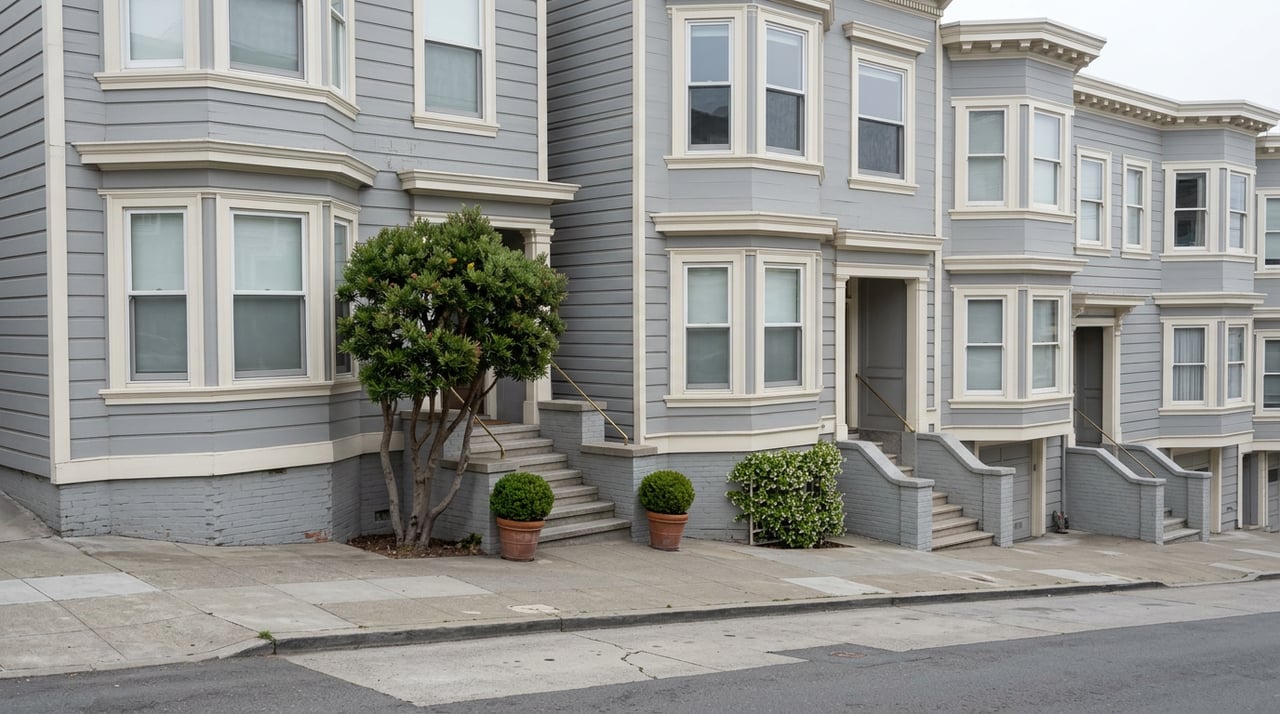
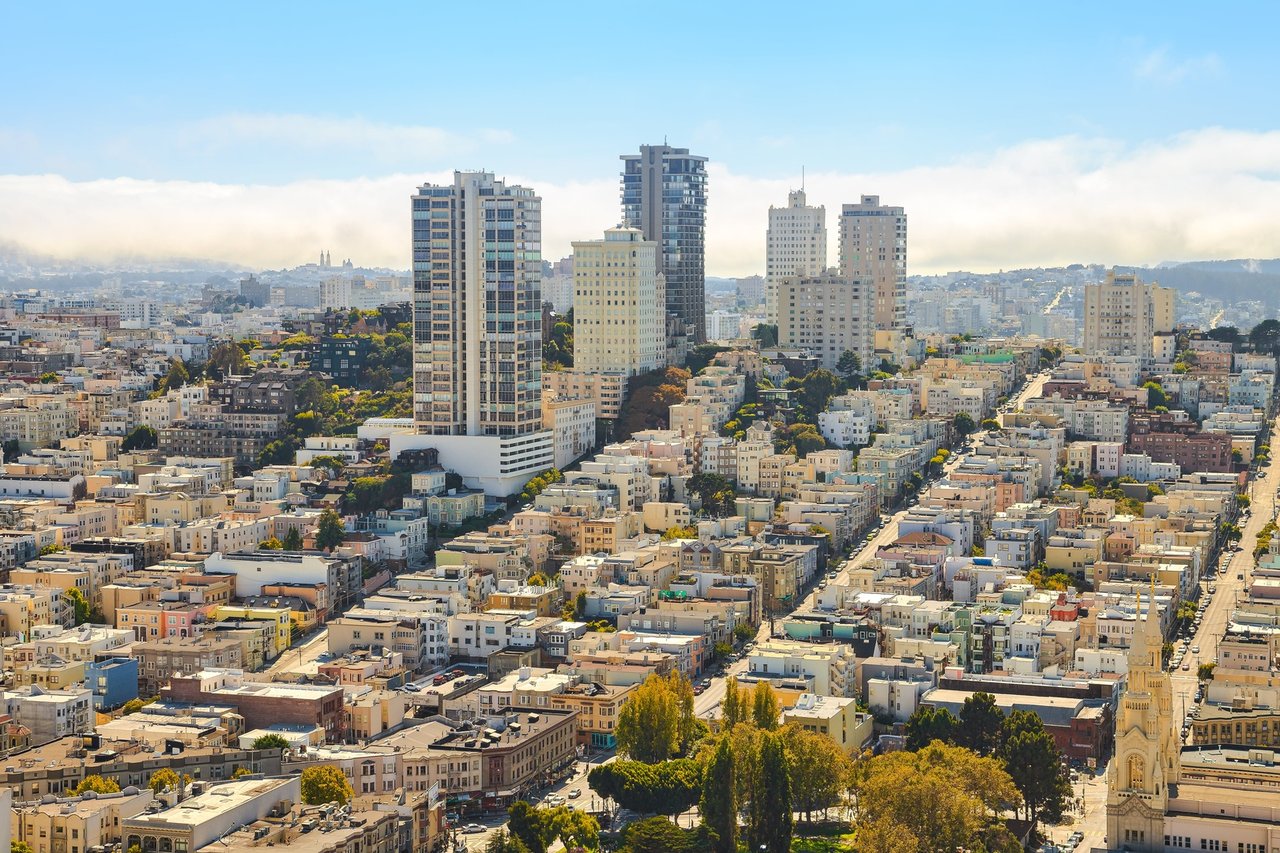
The housing stock in Nob Hill looks different than a lot of the neighborhoods I cover. This isn't a single-family home neighborhood. Because it was rebuilt on such valuable, centrally located land after 1906, Nob Hill became one of the city's earliest high-density residential neighborhoods, full of prewar co-op and condo towers alongside smaller Victorian and Edwardian buildings that have been carved up into apartments and condos over the decades.
Some of those prewar towers are genuinely architecturally significant — elegant brick and stone buildings from the 1920s and '30s that give the neighborhood its skyline. There are also mid-century high-rises mixed in, along with smaller multi-unit buildings closer to Polk Street, and a small amount of newer construction.
875 California Street (Crescent Nob Hill)
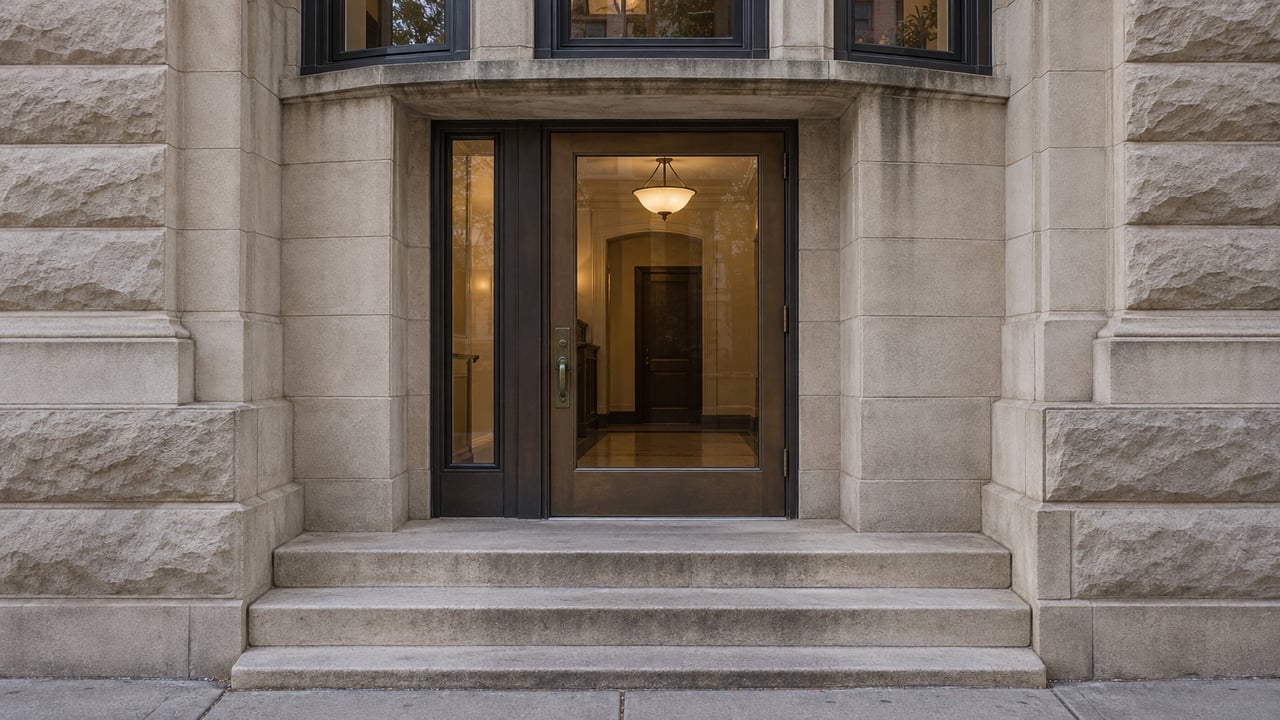
One building breaks the mold completely. 875 California Street, also known as Crescent Nob Hill, sits at the corner of Powell and California and was the first new residential building constructed on Nob Hill in roughly 40 years when it was completed. It was designed by Robert A.M. Stern Architects, one of the most respected classical architecture firms in the country, with just 44 residences and high-end interiors from the same firm behind the Carlyle in New York. It's a doorman building with a fitness center, rooftop, and a courtyard with a fireplace — construction of this type is really rare to see in Nob Hill.
If you want the Nob Hill address and the Nob Hill history but don't want a prewar building's quirks — no elevator, no central air, decades-old plumbing — 875 California is really the only option in the neighborhood that gives you both. And if you're set on a single-family home with a yard, this isn't the neighborhood for you: there are only a handful remaining in Nob Hill, maybe six or so. But if you want a full-service condo or co-op building in what might be the most walkable, most centrally located part of the city, this is exactly where you look.
What Is the Nob Hill Real Estate Market Like Right Now?
Despite being so close to downtown, Nob Hill didn't experience quite the same pandemic-era downturn as other neighborhoods within walking distance of San Francisco's commercial hub, like South of Market, South Beach, Yerba Buena, and Jackson Square.
● Price per square foot: over the past six years, average price per foot fell 1.8% in those other close-to-downtown areas, but rose 13.8% in Nob Hill.
● Median sale price: was flat in Nob Hill over that same period, compared to a 3.2% decline in those other areas.
● Year-over-year performance: both median sale price and average price per foot are up more than 11% year over year, consistent with the broader San Francisco condo market's recovery.
● Inventory: new listings are down 27% so far this year, with only about 1.3 months of supply on the market — a 50% drop compared to the first half of last year.
Because Nob Hill has unique qualities compared to other close-to-downtown neighborhoods, it held up better during the citywide downturn, and it's now benefiting from its proximity to where San Francisco's resurgence is happening. With limited new listings and thin supply, pricing is likely to keep climbing as more people return to the office, city conditions improve, and AI continues to fuel San Francisco's market.
Frequently Asked Questions About Nob Hill
Why is it called Nob Hill?
The name comes from "nabob," a British term for a flashy, powerful man who made his fortune overseas. It was used to describe the railroad and silver barons who built extravagant mansions on the hill in the 1870s and 1880s, and by around 1876 the shortened version, "Nob Hill," had stuck.
What are the boundaries of Nob Hill?
Nob Hill is roughly bound by Van Ness Avenue to the west, Broadway to the north, Bush Street to the south, and Stockton Street to the east, though sources vary slightly on the exact lines.
Do you need a car to live in Nob Hill?
Most residents don't. Nob Hill has a Walk Score of 99, all three of San Francisco's remaining cable car lines run through it, and several Muni bus lines connect it directly to downtown and surrounding neighborhoods.
Are there single-family homes in Nob Hill?
Very few. Nob Hill is dominated by prewar condo and co-op towers, along with converted Victorian and Edwardian buildings. Only a small handful of single-family homes, roughly six, remain in the neighborhood.
Is Nob Hill a good place to buy real estate right now?
Nob Hill has outperformed comparable close-to-downtown neighborhoods over the past several years and is currently seeing rising prices alongside a sharp drop in available inventory, which points to continued price growth.