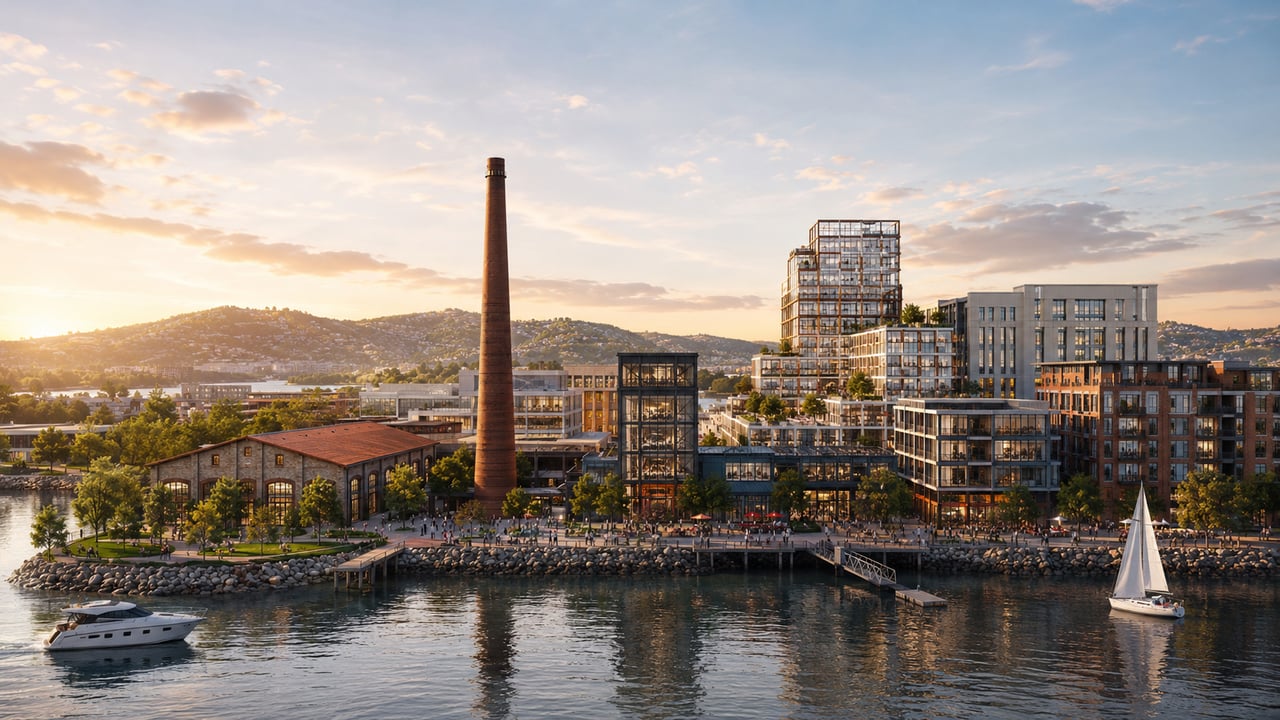
Potrero Power Station: What's Happening at San Francisco's Newest Waterfront Redevelopment?
Quick answer: Potrero Power Station is a 5.3 million square foot mixed-use redevelopment of a defunct power plant on San Francisco's central waterfront, led by developer Associate Capital. The approved plan includes more than 2,600 homes, 1.6 million square feet of commercial and lab space, a 250-room hotel, nearly 100,000 square feet of retail, and close to 7 acres of open space. Phase 1, with over 700 homes and the first waterfront park, is already underway, and it's opening a stretch of San Francisco waterfront to the public for the first time in 150 years.
Where Is Potrero Power Station Located?
The Potrero Power Station site sits along San Francisco's central waterfront, bound by Illinois Street to the west, 22nd Street to the north, 23rd Street to the south, and the Bay to the east. It's close to Third Street, the main transit corridor running north to south through the Financial District and connecting the site to the other communities being built along the central waterfront.
The location also has some of the best weather in San Francisco. The cold and fog fronts that roll in off the Pacific don't reach this side of the city, so it trends warmer here than in most other neighborhoods. The site is also relatively flat, which makes it walkable and well suited to outdoor exercise, dog walking, and recreational sports, all of which factor directly into the development plans.
To make those plans possible, the developer and Perkins & Will, who designed the master plan for the site, had to rezone the property from heavy industrial use to mixed use.
What Was the Power Station Used For Historically?
A century ago, the power plants at this site powered San Francisco's electrical grid and helped the city become what it is today. In the late 19th century, San Francisco Gas Light built a small generator here, the first power plant for the company that eventually became PG&E.
Today the site houses two power plants: Station A, built in 1899, and a 130-foot steel plant called Unit 3, next to the turbine at the waterfront. At its peak, the plant generated about a third of San Francisco's power. Over time the city adopted more efficient and environmentally friendly power generation, and residents pushed for the plant to close. Governor Newsom shut it down in 2010, and it's sat largely unused since.
Associate Capital purchased the site in 2016 and plans to keep both historic plants standing as anchors of the development, repurposing them into focal points of the new community rather than tearing them down.
What Is Being Built at Potrero Power Station?
The power station site is currently approved for over 2,600 homes, 1.6 million square feet of commercial space, a 250-room waterfront hotel, and nearly 100,000 square feet of retail. All in, the development totals about 5.3 million square feet.
Every part of it is oriented toward the water. The design framework routes all of the neighborhood's streets directly to the Bay. Pedestrians will get access to a one-acre waterfront park called The Point, featuring discovery play elements, public art, social seating, picnic space, bird watching areas, and views of the city, the Bay Bridge, and the East Bay hills.
Phase 1 Progress
● Infrastructure: roughly $400 million in site work is converting the property from industrial to mixed use, including new underground utilities, streetscape and curb work, a seawall to withstand sea-level rise, and demolition of old buildings. Former Mayor London Breed helped push through the legislative approvals needed to finance the work.
● Waterfront access: the developer has built a seawall and is placing pilings for a future dock that will support ferry service along the waterfront, including a connection to the Ferry Building, giving future residents an easy public-transit link to the Embarcadero and downtown.
● Sophie Maxwell Building: the first residential building on site, designed by Leddy Maytum Stacy Architects. The 85-foot building will bring 105 workforce housing units, fully reserved for households earning no more than 80% of area median income.
● Unit count: Phase 1 is expected to deliver more than 700 units, over twice the number originally planned, alongside several blocks of the project and some of the new parks.
The commercial space originally planned as office is shifting toward lab and life-sciences space given recent office vacancy trends. UCSF is in discussions to become an anchor tenant, exploring a clinic, a precision cancer center, and an incubator for new health technology on a 50,000-square-foot parcel near the Sophie Maxwell Building.
Which Architects Are Designing Potrero Power Station?
The developer has brought in some of the most recognized architecture and design firms in the world. Herzog & de Meuron, the Swiss firm behind the de Young Museum in Golden Gate Park, is leading the adaptive reuse of Station A into an office and life-sciences building, along with buildings on multiple blocks of the site.
Foster + Partners, known locally for its work on the Transamerica Pyramid renovation and the Apple campus, is designing several of the ground-up residential buildings. Landscape firms CMG and Plural Studio are designing the site's new parks. CMG is also working on parks at the 8,000-unit Treasure Island redevelopment happening elsewhere in the city.
What's Nearby Potrero Power Station?
The whole point of this redevelopment is connectivity, taking a site that's been cut off from the rest of the city and tying it into some of San Francisco's best neighborhoods.
It's the third in a string of new mixed-use waterfront communities, joining Pier 70 and Mission Rock just to the north, both already underway with buildings open in their first phases. Nearby you'll also find the Chase Center, home of the Golden State Warriors, and the 11-acre Thrive City restaurant and bar district next to it, along with the new RH restaurant and rooftop and Building 12's food and padel facilities at Pier 70.
The site is walking distance to Dogpatch and a short drive to Potrero Hill, SoMa, and the Financial District. What was once an isolated industrial site is becoming one of the best-connected pockets of the city.
Frequently Asked Questions
What is being built at Potrero Power Station?
A 5.3 million square foot mixed-use community with more than 2,600 homes, 1.6 million square feet of commercial and lab space, a 250-room hotel, retail, and nearly 7 acres of open space, built around a defunct power plant on San Francisco's central waterfront.
Who is developing Potrero Power Station?
Associate Capital, which purchased the site in 2016, is leading the redevelopment with a design team that includes Perkins & Will, Herzog & de Meuron, and Foster + Partners.
When will homes be available at Potrero Power Station?
Phase 1, including the Sophie Maxwell Building and more than 700 total units, has been underway with deliveries targeted on a rolling basis as infrastructure and individual buildings are completed. Reach out for the latest on what's actually open and available.
Was Potrero Power Station really a power plant?
Yes. The site housed two power plants, Station A from 1899 and a later plant called Unit 3, which together once generated about a third of San Francisco's electricity before Governor Newsom ordered the plant closed in 2010.
What's near Potrero Power Station?
The Chase Center and Thrive City, Pier 70 and Mission Rock, and the Dogpatch neighborhood are all within walking distance, with Potrero Hill, SoMa, and the Financial District a short drive away.
I moved to the Bay Area over a decade ago to work as a lawyer at one of the biggest firms in the world, and I've since helped people relocate here from all over the country. Developments like this one are reshaping the central waterfront in real time, and it's worth understanding how they'll affect values in Potrero Hill, Dogpatch, and the surrounding neighborhoods. If you're thinking about buying near the waterfront and want to talk through what this means for the market, reach out. I'm happy to be a resource for you.