Duboce Park Historic District: History, Homes, and Prices (2026 Guide)
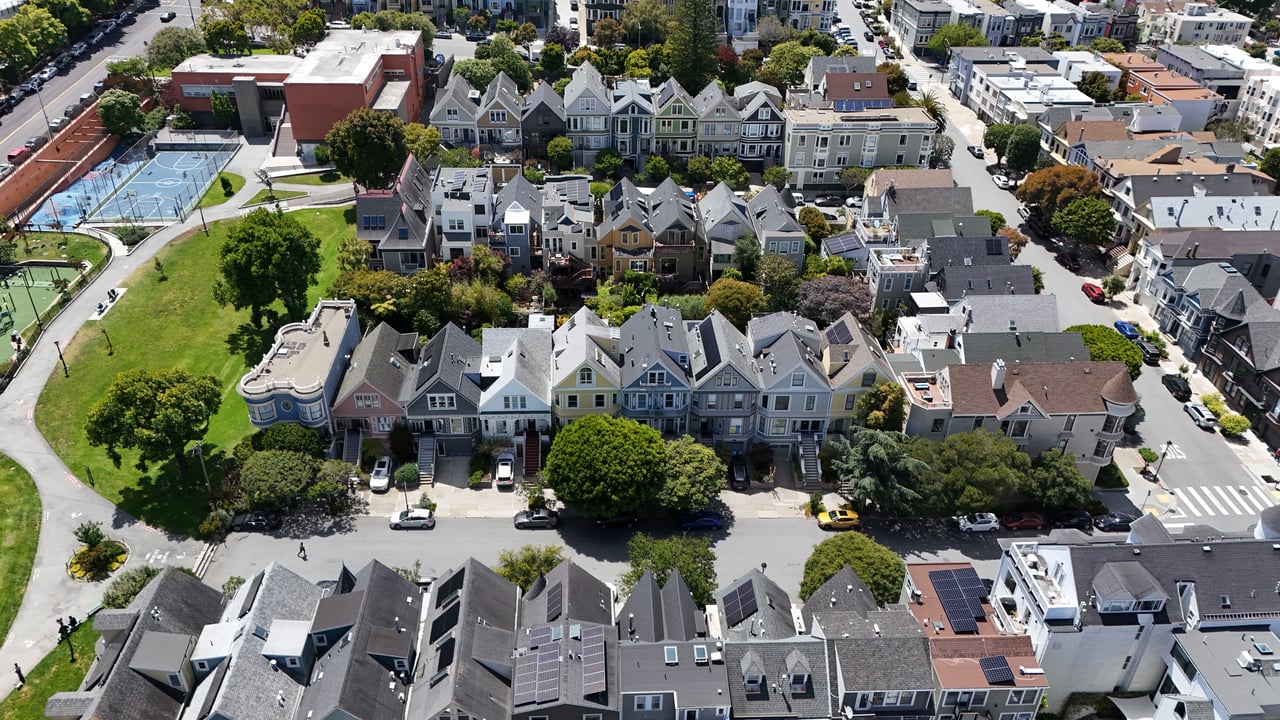
Quick answer: The Duboce Park Historic District is a three-block enclave of Carmelita, Pierce, and Potomac Streets on the northern edge of Duboce Park in San Francisco's Duboce Triangle neighborhood. It's one of the city's few official Article 10 landmark districts, home to 87 Victorian and Edwardian houses built almost entirely between 1899 and 1900. The streets dead-end straight into the park with no sidewalk in between, a layout found nowhere else in San Francisco. Homes here routinely sell in the $5–7 million range and rarely stay on market more than a week.
If you've walked along the north edge of Duboce Park and wondered why those three little streets feel different from everywhere else in the city — tucked, quiet, oddly perfect — there's a real reason for that. It comes down to a forty-year property dispute, a pile of leftover construction rubble, and two builders who happened to be working at exactly the right moment in San Francisco history.
I'm Austin Klar. I practiced law in San Francisco before moving into real estate, and I've spent the years since helping people buy, sell, and understand this city block by block. Duboce Park Historic District is one of those pockets that almost nobody outside San Francisco has heard of, and even a lot of longtime residents don't know the backstory. So let's get into it.
Where Is the Duboce Park Historic District?
The district covers Carmelita Street, Pierce Street, and Potomac Street, right where they meet the north side of Duboce Park in the Duboce Triangle. It sits within easy reach of the Castro, the Lower Haight, and Hayes Valley, and it's one of only a small handful of neighborhoods in San Francisco with a formal landmark designation under Article 10 of the Planning Code.
Why Do the Houses on Carmelita and Potomac Dead-End Into the Park?
This is the detail that makes the neighborhood, and it goes back further than most people expect.
In 1856, the city set aside this block of land — bounded by today's Duboce Avenue, Scott Street, Waller Street, and Steiner Street — as a public reservation, with the idea that it would eventually become parkland like Alamo Square or Lafayette Square. Then nothing happened for about forty years, because nobody could agree on who actually owned it.
Squatters moved in. Courts granted pieces of the land to private citizens over the city's objections. At one point the city tried to turn it into a hospital site and leased it out, but no hospital ever got built. What actually took root was a mess: stables, temporary boarding houses for laborers, and lodging for people believed to be carrying disease. Around the same time, a large excavation project on 14th Street needed somewhere to dump rock, and this vacant lot became the dumping ground — piles of debris several feet high. Neighbors got fed up enough to form the Hospital Lot Improvement Club and petition the city to clean it up.
Eventually the German Savings and Loan Association assumed ownership of part of the land and sued the city over title. In 1896, after decades of legal back-and-forth, the city gave up its claim to the northern half. The bank took ownership, and in July 1897 it deeded new interior streets to the city — extending Pierce Street south of Waller and creating two brand-new dead-end streets it named Primrose and Daisy. Those two streets are the ones we know today as Carmelita and Potomac.
The bank ran all three streets straight into what would become the park, with no buffer between the last row of houses and the grass. That single decision from 1897 is why, over a century later, homes on Carmelita, Pierce, and Potomac still back directly onto Duboce Park with no street or sidewalk in between. It's a block arrangement you won't find replicated anywhere else in San Francisco.
Even the rubble that had been a neighborhood nuisance got put to use — it became foundation material for the new houses and for the ornamental entrances still standing at the park today. Duboce Park itself was formally dedicated on September 9, 1900, named for Colonel Victor Duboce, a Spanish-American War veteran who had pushed to turn the old hospital lot into public green space. The area came through the 1906 earthquake largely unscathed, which is part of why so much of the original construction still stands.
Who Built the Homes in Duboce Park Historic District?
Nearly two-thirds of the buildings in the district went up in 1899 and 1900 — an unusually compressed construction window that gives these three streets a visual consistency you rarely see in San Francisco, where most neighborhoods filled in piecemeal over decades.
● Carmelita and Pierce Streets: primarily built by Fernando Nelson, who over a 77-year career constructed more than 4,000 houses across San Francisco. Duboce Park was one of his earliest major developments.
● Potomac Street: primarily built by George Moore and Charles Olinger, a carpenter and lumber dealer working in partnership.
● Waller and Steiner Streets: mostly Classical Revival, with Queen Anne detailing mixed in.
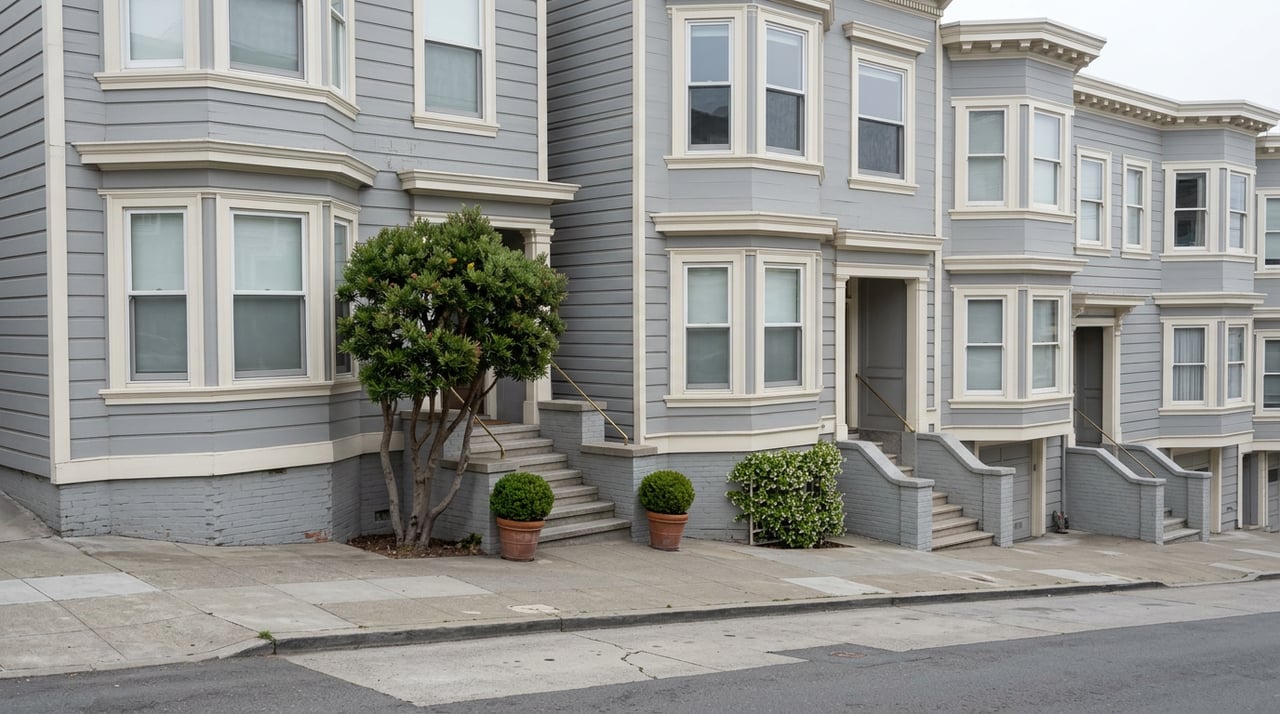
The dominant architectural style throughout is Queen Anne: asymmetrical facades, steep front-facing gable roofs, angled bay windows, fish-scale and diamond shingle patterns in the gables, turned wood spindle work on the porches, and witch's-cap turrets on the corner buildings. These homes were built at the exact peak of San Francisco's redwood millwork industry, when local mills were turning out an enormous range of decorative trim — and the builders here used just about all of it.
Who Has Lived in the Duboce Triangle Over the Years?
The social history here tracks the broader story of San Francisco.
The earliest residents in the late 1890s and early 1900s were solidly middle-class — shipwrights, clerks, insurance agents, tailors — people who could afford to buy into a new development near the cable car lines. Moore and Olinger, the builders on Potomac, lived alongside the people who bought their houses.
After the 1906 earthquake and the tent-camp years that followed, the neighborhood rebuilt and grew denser. By the 1940s and into the '50s, as wartime defense work drew new residents to San Francisco, a large number of African American families settled in the nearby Western Addition. Then in the 1960s, as the San Francisco Redevelopment Agency displaced thousands of families from the Western Addition through urban renewal — one of the more painful chapters in the city's history — many of those families relocated into the Duboce Triangle.
By the late 1970s, the Castro was becoming the center of gay life in San Francisco, and new residents, many of them gay or lesbian, moved into the Duboce Triangle as well. They're widely credited with restoring the Victorian facades, repainting the houses in the vibrant colors the neighborhood is known for today, and reviving the block's character after years of neglect. The neighborhood today is diverse, close-knit, and active — the neighborhood association has been involved in everything from the historic designation process to ongoing park improvements.
What's It Like to Live Near Duboce Park?
If you're weighing a move here, the day-to-day livability is a big part of the draw.
Duboce Triangle carries a Walk Score of 98, a Bike Score of 89, and a Transit Score of 93 — exceptional numbers even by San Francisco standards. Most people who live here genuinely don't need a car.
The park itself is the anchor of the neighborhood: off-leash dog areas, a lawn that fills up with picnickers whenever the fog breaks, tennis courts, and a playground. The Harvey Milk Recreation Center sits at the park's western edge and includes the oldest public community darkroom still operating in San Francisco. The Muni Sunset Tunnel portal is right at the park's edge, and the N, J, K, L, M, and T lines all run through or near the area, putting you in the Castro in minutes, SoMa in about ten, and the Ferry Building in around fifteen, with BART and Caltrain both within reach.
For cyclists, this is one of the best-positioned spots in the city — the Wiggle, San Francisco's famous low-gradient bike route from the Embarcadero out to Golden Gate Park, runs directly through the neighborhood, and Market Street's protected bike lanes connect right into it. If you do drive, the 101 on-ramp is close and Market Street gets you across town quickly.
Weather-wise, the location sits in a comfortable middle ground — not buried in the Sunset's fog belt, not baking in the Mission's sun belt. And with Castro, the Lower Haight, and Hayes Valley all within a few blocks, your dining and nightlife options extend well past the immediate neighborhood.
How Much Do Homes Cost in the Duboce Park Historic District?
Given the walkability, the transit access, and the architecture, it's no surprise these homes carry premium price tags — and inventory almost never sits long enough to test the market.
Two recent sales illustrate the range:
● 50 Carmelita — a fully remodeled 4-bed, 4.5-bath Queen Anne Victorian built in 1899, sitting right at the edge of the cul-de-sac on the park. Listed at $5.8M, it closed in June 2026 for $7.3M, roughly $1,900 per square foot.
● 65 Carmelita — needed more updating and wasn't positioned directly on the park. Listed at $4.4M, it closed in January 2026 for about $5.65M, roughly $1,638 per square foot.
Both sold in under a week. When a home in this district comes on market, buyers move fast, because inventory here is genuinely rare — this is a three-block district with only 87 homes total.
What Are the Tradeoffs of Buying in a Historic District?
Landmark status protects what makes this neighborhood special, but it also comes with real constraints buyers should understand before they fall in love with a listing.
Exterior changes are tightly restricted. Replacing doors or windows has to match the historic character, which typically means custom millwork and custom trim — more cost, more time. Adding a garage, enlarging an opening, or relocating a window or door is extremely difficult, often not permitted at all. Even something like adding a dormer to open up ceiling height on the top floor usually isn't allowed if it would be visible from the street, and any exterior change you do pursue can draw pushback from neighbors invested in preserving the block's character.
On the upside, many of these homes qualify for the Mills Act, a program that reduces property taxes in exchange for a formal commitment to maintain the home's historic integrity. Depending on the property, that can save an owner tens of thousands of dollars a year — a meaningful offset against the premium you're paying to own here.
Duboce Park Historic District FAQ
Is Duboce Park Historic District a good investment?
Scarcity is the core driver here — only 87 homes exist in the district, turnover is low, and recent sales have closed well above asking within days of listing. That said, historic status limits renovation flexibility, which matters if your plan involves significant exterior changes.
Is the Duboce Triangle walkable?
Yes. It carries a Walk Score of 98, a Bike Score of 89, and a Transit Score of 93, among the highest combinations in San Francisco.
What style are the homes in Duboce Park Historic District?
Primarily Queen Anne Victorian, with Classical Revival buildings concentrated on Waller and Steiner Streets. Most of the district was built between 1899 and 1900.
Can I renovate a home in a San Francisco historic district?
You can, but exterior work is regulated to preserve the historic character — expect custom millwork, longer permitting timelines, and possible neighborhood input on visible changes. Interior renovations generally have far more flexibility.
Thinking About Buying or Selling Near Duboce Park?
Neighborhoods like this one don't show up on a spreadsheet the way they show up on the street — you have to know the history, the permitting quirks, and how rarely inventory actually turns over before you can advise someone well. I've spent nearly 14 years in San Francisco, and before real estate, I practiced law at one of the largest firms in the world, which shapes how I approach contracts, disclosures, and negotiations for my clients today.
If you're weighing a purchase or sale in the Duboce Park Historic District, or anywhere else in San Francisco, and want a clear read on how the current market is moving, reach out. I'm happy to be a resource, no pressure, no obligation — just a conversation about what makes sense for your situation.