Quick answer: Candlestick Point, the former home of the San Francisco 49ers, is a roughly 280-acre waterfront site in the city's southeast that has sat largely undeveloped since Candlestick Park was demolished in 2015. After a decade of delays tied to a separate radiological cleanup scandal at the neighboring Hunters Point Shipyard, the city formally decoupled the two projects in November 2024. Infrastructure work is now set to begin in 2026, with the first new homes expected by 2030 and the full 7,200-unit build-out realistically stretching into the 2040s.
If you've driven down Highway 101 past the old Candlestick Park site, you've probably noticed the same thing I have for years: road signs bearing the names of 49ers legends, pointing at empty land. For over a decade, one of the most historically significant parcels in San Francisco has sat almost untouched, despite promises of a thriving new waterfront neighborhood with thousands of homes, parks, retail, and jobs.
I'm Austin Klar. I practiced law in San Francisco before moving into real estate, and Candlestick Point is one of the most layered development stories in the city — part sports history, part civil rights history, part environmental scandal, and now, finally, a real path forward. Here's everything you need to know about where the project stands, what's been built, and when you can actually expect to see homes on this site.
What Happened to the Site of Candlestick Park?
The Candlestick site sits about five miles south of downtown San Francisco, on a peninsula jutting into the bay in the southeastern part of the city. Candlestick Park opened here in 1960 as the home of the San Francisco Giants, and the 49ers took it over in 1971. For decades it was the beating heart of San Francisco football — Montana, Rice, Young, Walsh, four Super Bowl championships, some of the most iconic moments in NFL history.
The neighborhood surrounding the stadium, Bayview Hunters Point, is one of San Francisco's oldest and most historically significant Black communities — not a forgotten corner of the city, but one with deep civic roots and generations of families. Yet as the 49ers grew into a marquee franchise, the surrounding neighborhood didn't see the same investment other parts of San Francisco did. It stayed chronically underserved on retail, transit, parks, and economic opportunity.
A naval shipyard next door had once been the area's major employer, but after it closed in the 1970s, economic opportunity in the area declined and the site sat largely unused. Then, after years of trying to get a new stadium built in San Francisco, the 49ers left for Santa Clara and opened Levi's Stadium in 2014. Candlestick Park was demolished in 2015, leaving behind a roughly 280-acre cleared waterfront site — and a community that had been promised transformation and left, for years, with next to nothing new.
What Is the Plan for Candlestick Point?
The original development agreement between the city and the developer was signed in 2010, before the 49ers even left for Santa Clara. The vision was enormous: a new mixed-use community with up to 12,000 housing units split across two sites — Candlestick Point and the adjacent Hunters Point Naval Shipyard.
This was never just market-rate housing. The plan built in replacement housing for existing Alice Griffith public housing residents, deeply affordable units for low-income families, and workforce housing for middle-class families, alongside millions of square feet of commercial space, retail, parks, a hotel, and a performance arena.
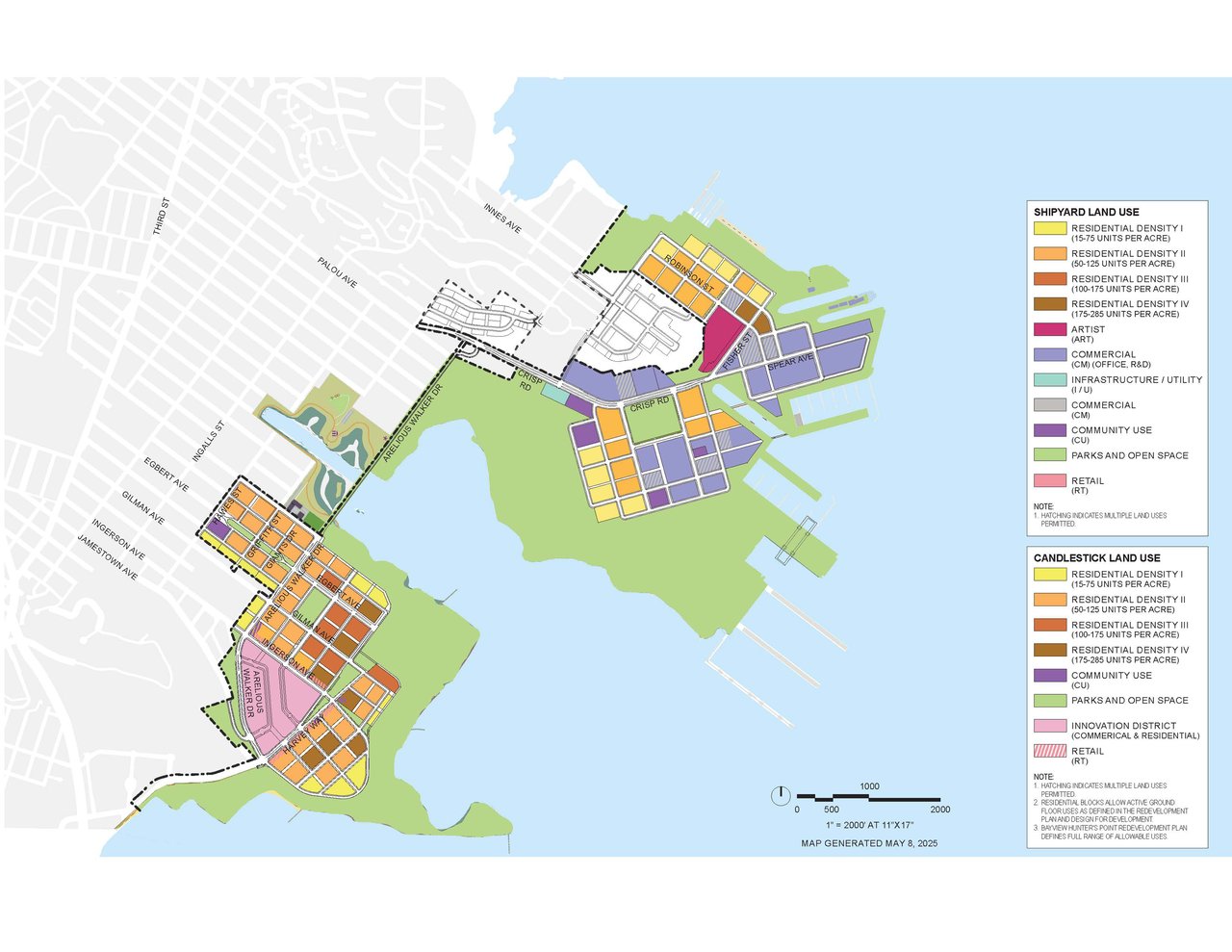
The site was divided into four distinct neighborhoods:
● Alice Griffith — the northern portion of the site, a blend of market-rate and affordable townhomes and low-rise buildings, roughly 1,300 homes total.
● Candlestick North — a mix of low-, mid-, and high-rise residential buildings built around a central community park.
● Candlestick South — transit-focused, with buildings tapering down toward the water and the State Recreation Area.
● Candlestick Center — the commercial heart of the project, meant to serve as the new town center with the densest mix of residential, retail, and commercial activity.
Together, the vision calls for a waterfront park system running the length of the shoreline, five new city parks, tree-lined streets and pedestrian greenways, and a rapid transit line connecting residents to BART, Caltrain, and the rest of the city. Building heights across the site range from 40 feet near the waterfront up to 320 feet for the tallest planned tower inland — a new neighborhood, at full build-out, for tens of thousands of people.
Who Is Developing Candlestick Point?
The developer behind the project is FivePoint Holdings, an Irvine-based firm that specializes in large-scale, master-planned communities. FivePoint is a spinoff of Lennar, one of the nation's largest homebuilders — Lennar was originally awarded the rights to develop the Hunters Point Shipyard back in 1999, and the Candlestick project was later folded into that same framework since the two sites sit next door to each other. The city's partner on the public side is the Office of Community Investment and Infrastructure, known as OCII.
Why Has Candlestick Point Redevelopment Taken So Long?
This is the question anyone following this project eventually asks: with a grand vision, a major developer, and full city support, why did basically nothing happen for over a decade? The answer has almost nothing to do with Candlestick Point itself and everything to do with the neighboring Hunters Point Shipyard.
The two sites were always linked. The original development plan treated Candlestick and the Shipyard as one combined 702-acre project, planned and financed together under a single development agreement. The Hunters Point Naval Shipyard was decommissioned after World War II and used by the Navy through much of the Cold War — and critically, it was used in the early 1950s to decontaminate ships that had been exposed to radiation from nuclear weapons tests in the South Pacific. That decontamination work spread radioactive material throughout the shipyard, which is why the EPA designated it a Superfund cleanup site in 1989.
A contractor named Tetra Tech was hired by the Navy to handle the radiological remediation. In 2012, evidence of alleged fraud emerged — Tetra Tech employees had reportedly falsified soil samples to make it look like cleanup work had been completed when it hadn't. Two former supervisors ultimately pleaded guilty to falsifying records, and the cleanup effort ground to a halt while the Navy worked to redo years of contaminated data.
The Candlestick site itself was never contaminated — it doesn't share the Shipyard's radioactive history. But because the two projects were bound together in the same development agreement, the Shipyard's problems became Candlestick's problems. Funding timelines for both slipped, and Candlestick got dragged down by a mess that wasn't its own. As of late 2024, the EPA didn't expect cleanup of the adjacent Shipyard area to resume until 2027, with full remediation expected to take years beyond that.
What Changed in 2024 to Get Candlestick Moving Again?
In November 2024, the San Francisco Board of Supervisors unanimously approved a revised development agreement designed to unlock the stalled project. A few major changes came out of that vote:
● Decoupling: Candlestick and the Shipyard were formally separated, allowing Candlestick to move forward as a standalone development.
● A commercial shift: roughly 2 million square feet of office and R&D space originally planned for the Shipyard was reassigned to Candlestick, giving the site a much larger commercial and innovation component than the original, heavily residential plan.
● A longer runway: the overall project timeline was pushed back by roughly ten years.
● More financing capacity: the limit on bonded indebtedness for the project rose from $1.7 billion to $5.9 billion, giving FivePoint and the city room to fund the infrastructure work the site needs.
What Is the Candlestick Center Innovation District?
The revised agreement also introduced a new option for Candlestick Center, the commercial heart of the project. The base plan still calls for a retail-heavy, mixed-use town center with shops, restaurants, entertainment, and housing. But the amendments added a Candlestick Center Innovation District Alternative — a live-work-play campus centered on research, entrepreneurship, and the biotech and AI industries that have been driving San Francisco's economic recovery. Think of it as an attempt to bring some of Mission Bay's biotech energy, or SoMa's tech scene, out to the southeastern waterfront.
The developer has also acknowledged that Candlestick Center sits within San Francisco's designated African American Arts and Cultural District, and the plan calls for public art and design elements throughout the Innovation District that reflect that cultural heritage.
What's Actually Going to Get Built at Candlestick Point?
Housing
The major structural changes are financial and commercial — what's supposed to ultimately get built on the residential side remains largely unchanged. Townhomes with street-facing stoops and private patios sit at the ground level near the site's edges, echoing the human-scale feel of San Francisco's older neighborhoods. Low- and mid-rise buildings, four to eight stories, form the bulk of the residential density, similar to what you'd see in the Mission or Hayes Valley. High-rise towers, up to several hundred feet, are concentrated near transit stops, parks, and the retail core.
Parks and Open Space
The plan calls for acres of new parks, each with a distinct role. The Alice Griffith Community Park serves as the neighborhood commons for Alice Griffith residents, with playgrounds, a dog run, community gardens, and a basketball court. The roughly three-acre Candlestick Community Park sits near the center of Candlestick North. The most ambitious of the bunch is the Bayview Gardens and Wedge Destination Park — essentially the development's Central Park, a wedge-shaped greenway running from the site's center down to the State Recreation Area, filled with ecological gardens, reflecting ponds, and shade pavilions, designed to be a destination for the whole city, not just residents.
Then there's the Candlestick Point State Recreation Area itself — all 121 acres of shoreline. The plan calls for a complete refurbishment: restoring native grasslands and woodland groves, adding kayak, canoe, and windsurfing access, upgrading fishing piers, expanding pocket beaches, and — notably — closing the largest remaining gap in the San Francisco Bay Trail, which would finally make it possible to walk or bike the entire trail from Candlestick north to the rest of the city.
Waterfront and Streetscape
The bay shoreline is treated as the site's most valuable asset, and the plan orients the entire development toward it — every major street runs perpendicular to the water, creating unobstructed view corridors from the inland residential blocks all the way to the bay. Combined with the CPSRA improvements, it adds up to one of the largest stretches of rejuvenated waterfront infrastructure planned anywhere in San Francisco.
Connectivity has always been one of the site's biggest historical weaknesses — Candlestick has long felt disconnected from the rest of the city. The plan addresses that with new bus rapid transit, an expanded bike network, and a connected shoreline. Perkins and Will, the architecture firm assisting FivePoint on the master plan, has a track record on major projects worldwide, which gives the design team real credibility heading into this next phase.
What's Already Been Built at Candlestick Point?
So far, the only major construction completed on the broader site is the rebuilt Alice Griffith neighborhood — the public housing replacement component. The original Alice Griffith development, known locally as Double Rock, had 256 units in fairly poor condition. FivePoint enlisted nonprofit housing developer McCormack Baron Salazar to rebuild it; construction began around 2014, with the first families moving into new units in 2016 and 2017, and 90% of the original families successfully relocated into the new housing.
When Will New Homes Be Ready at Candlestick Point?
As of summer 2026, infrastructure work is set to begin — sewer systems, streetscape, sidewalks, the electrical grid, all the unglamorous groundwork a new development needs before vertical construction can start. That work is expected to pave the way for the first roughly 700 new units San Francisco has seen on this site in years.
If construction begins in earnest in 2026 or 2027, those first units wouldn't be ready to move into until 2030 at the earliest. The full build-out — all 7,200 homes, the Innovation District, the commercial space, and the waterfront parks — is now expected to take decades, with the ten-year timeline extension built into the 2024 agreement pointing toward a realistic completion sometime in the 2040s.
Candlestick Point Redevelopment FAQ
Is anything being built at Candlestick Point right now?
Yes. Infrastructure work — sewer, streetscape, electrical — is beginning in 2026, ahead of the first roughly 700 new residential units. The only major construction completed to date is the rebuilt Alice Griffith public housing community.
Why was Candlestick Point development stalled for so long?
Candlestick was contractually tied to the neighboring Hunters Point Shipyard, which faced a major radiological cleanup scandal after a Navy contractor was found to have falsified soil testing data. The city formally separated the two projects in November 2024, freeing Candlestick to move forward on its own.
How many homes will Candlestick Point eventually have?
The full build-out calls for roughly 7,200 homes across a range of densities, from ground-level townhomes to high-rise towers near transit and retail hubs, alongside millions of square feet of commercial and innovation space.
Is Candlestick Point contaminated like the Hunters Point Shipyard?
No. The Candlestick site does not share the Shipyard's radioactive contamination history. The delays were caused by the two projects being tied together administratively and financially, not by environmental issues on the Candlestick land itself.
Watching Candlestick Point? Let's Talk About What It Means for the Market
Projects at this scale move slowly, but they reshape a city's map once they land — new transit connections, new parks, thousands of new homes on a waterfront that's been underused for decades. I'll keep covering Candlestick closely as infrastructure work gets underway and the first units move toward construction.
If you're thinking about buying or selling in San Francisco and want to understand how developments like Candlestick Point, Potrero Power Station, Mission Rock, Pier 70, and the Railyard at 4th and King are reshaping the market, reach out. I've lived in San Francisco for over thirteen years and have helped numerous people relocate here from all over the country. Happy to be a resource, no pressure, no obligation — just a conversation about what makes sense for you.