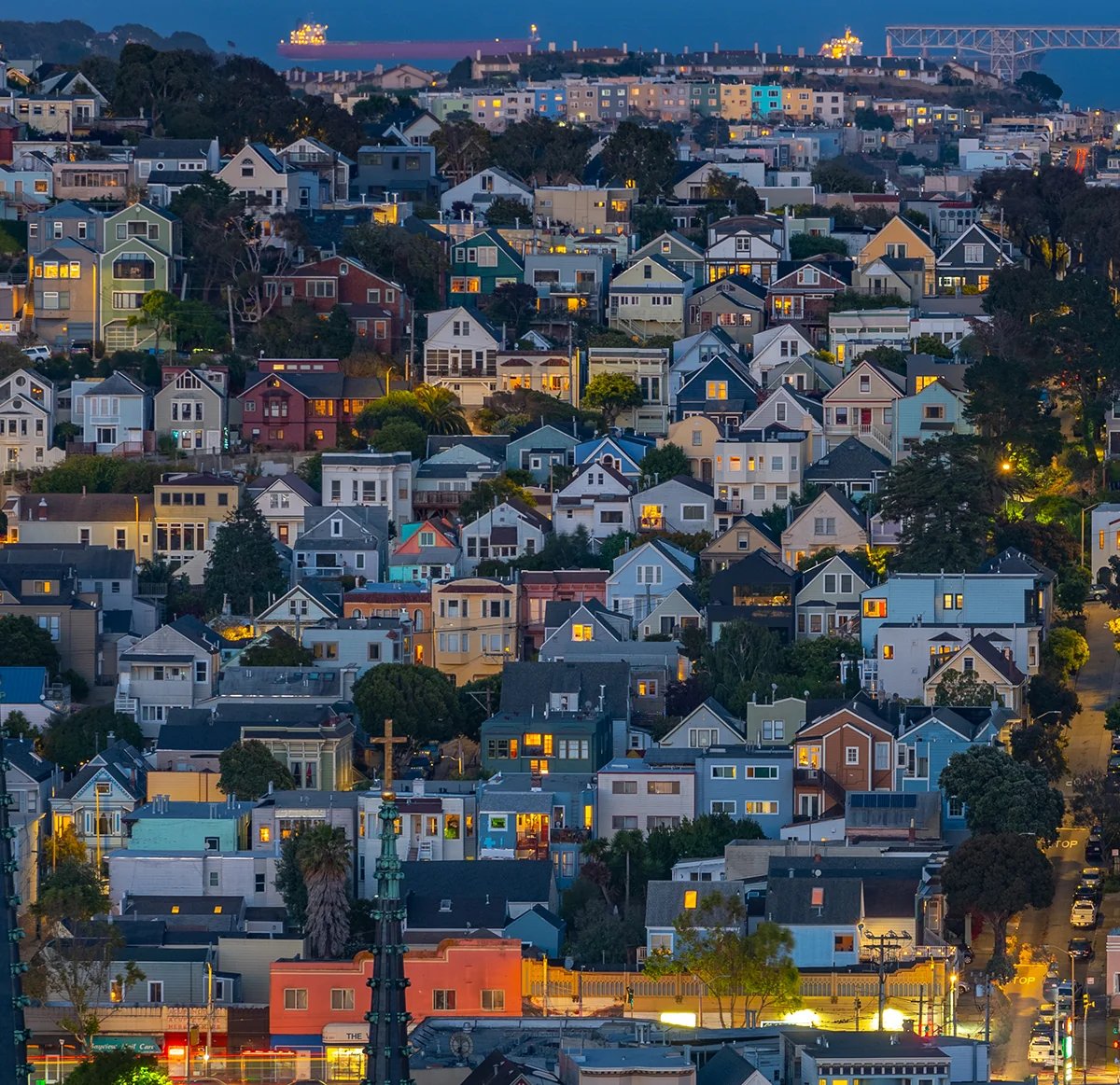
If you live in San Francisco or have visited recently, there's a good chance you've walked past at least one of these sites without realizing what's planned there. Some are mega skyscrapers in and around downtown. Others are smaller projects that could quietly reshape how entire neighborhoods look and feel.
I'm a lawyer turned real estate agent, and every day I talk with residents and people thinking about moving here who want to know how projects like these affect the local market and day-to-day life. So I track major developments across the city every week, from small retail and housing projects to industrial sites and massive office towers. These six give a clear picture of where San Francisco is going across several sectors. Some are in early planning, some are fully approved, and some are already moving toward construction.
What are the biggest development projects in San Francisco right now?
• Fifty at First (SoMa): A proposed 56-story, 900-plus-foot all-office tower on the site locals called "The Pit."
• 230 Anza Street (Inner Richmond): An eight-story condo building, the first approved under the Family Zoning Plan.
• 900 Seventh Street (Showplace Square): Amazon's proposed 710,000-square-foot delivery station, now in environmental review.
• Fourth and Harrison (SoMa): BXP's approved two-tower office complex, waiting on an anchor tenant.
• The Jackson, 530 Sansome Street (Jackson Square): A 41-story tower with a 200-room five-star hotel and premium office.
• 10 South Van Ness (Civic Center / Market Street): A 67-story, 921-home tower that would be the tallest residential building in San Francisco history.
What is Fifty at First, and what happened to the Oceanwide Center?
If you've walked down First Street between Market and Mission in the last six years, you know this site: concrete foundations, exposed rebar, rusting steel, and a giant hole in the middle of the city. Locals just called it The Pit. It was formally the Oceanwide Center. Now it has a new name and a new plan.
The Fifty at First proposal
On September 17, the site's new owner, the San Francisco Recovery Fund, unveiled Fifty at First: an all-office tower of 56 stories, more than 900 feet tall, with roughly 1.5 million square feet of space. If it were built today, it would be the second tallest building in San Francisco, behind only Salesforce Tower.
• Architect: Gensler
• Landscape: Field Operations, the firm behind New York's High Line and the Presidio Tunnel Tops
• Development, leasing and marketing advisor: BXP, co-developer of Salesforce Tower
• Leasing agent: JLL
• Art program: SFMOMA is consulting
• Key features: A lobby roughly 50 feet tall, about 20,000 square feet of outdoor space, and extra-tall floor-to-floor heights, the kind of spec top-tier tenants pay for
The team is targeting an opening as early as 2031. As of the reveal, though, plans had not been formally filed with the city. For now, this is a vision, not an approval.
How did the Oceanwide Center site stall?
In 2015, Beijing-based Oceanwide Holdings bought the site for $296 million. The plan was two towers designed by Foster + Partners, with Heller Manus as local architect. The taller tower, about 910 feet, would hold office space and luxury condos. The second, about 600 feet, would have a Waldorf Astoria hotel and more residences. It was roughly a $1.6 billion project, and construction started in 2016.
By 2019, Oceanwide was struggling to raise capital and work stopped on the shorter tower. The pandemic made things worse, and work on the taller tower stopped in fall 2020. Years of litigation followed. In January of this year, the lender took the property at a foreclosure auction with a $100 million credit bid against more than $700 million in debt. The San Francisco Recovery Fund, led by SKS Partners co-founder Dan Kingsley and investor Jay Yang, later bought it for a reported $60 million. Oceanwide and its partners had put close to a billion dollars into the project before it stalled.
Why is the project moving forward now?
First, the price reset. Buying a site with foundation work already in the ground for pennies on the dollar changes the math on a new tower completely.
Second, the top of the office market has turned. Citywide vacancy is still high, but the trend and the trophy segment tell a different story:
• Citywide vacancy: About 29.2% at the end of Q2 2026 per CBRE, down from a peak of roughly 37% in 2024, with close to a million square feet of positive net absorption that quarter.
• Record leasing: Avison Young reported the first half of 2026 was the strongest first half for leasing on record in San Francisco, up more than 34% year over year.
• AI demand: CBRE attributes about 30% of all city office leasing since 2023, roughly 10 million square feet, to AI companies.
• Top-tier vacancy: Cushman & Wakefield put direct vacancy in Class A Tier 1 buildings at just 8.2% in Q2 2026.
• Rent premium: Avison Young reports trophy and Class A space commands about a 54% premium over Class B, on par with Manhattan.
So the bet here isn't on the office market as a whole. It's a bet that the best companies want the best buildings, and there aren't enough of them. It's the same logic behind the refreshed Transamerica Pyramid, which has been leasing its top floors at some of the highest rents in the country. It's a big bet, but a big step up from an abandoned hole in the ground.
What is the 230 Anza Street project, and why does it matter?
This is the smallest project on the list, and I think it may have the biggest long-term impact on the city.
At 230 Anza Street in the Inner Richmond, on a narrow lot across from the University of San Francisco's Lone Mountain campus, the Planning Commission unanimously approved an eight-story, roughly 85-foot condo building. It will have eight homes (six three-bedrooms and two two-bedrooms), balconies, a rooftop deck and a basement garage. Two units will be deed-restricted affordable housing. The developer is Oakland-based IvyHills LLC, and the architect is C.M. Wong Architecture.
The building replaces a vacant two-story structure, boarded up since 2019 with a damaged foundation, that IvyHills bought last summer for about $945,000. Its original plan was a 40-foot, three-unit building, consistent with the area's 40-X height limit.
What is the Family Zoning Plan?
230 Anza is the first project approved under Mayor Lurie's Family Zoning Plan, which the Board of Supervisors passed last December. The plan upzones portions of the west and north sides of the city, areas that for decades allowed almost no new density. A lot historically zoned for 40 feet now qualifies for more than double that height.
Neighbors opposed the project as out of character with the block, which is typical when a building is proposed at multiples of what's been built nearby. The commission approved it anyway, and one commissioner called this type of building "the new San Francisco."
Why does San Francisco need projects like this?
• State target: San Francisco must plan for more than 80,000 new homes by 2031.
• 2025 completions: 2,832 units, according to the Department of Building Inspection.
• 2026 so far: Only 413 units completed as of this summer.
Rebounding demand is colliding with an extremely supply-constrained market, which is a big reason rents have surged and competition for many homes has intensified. Without much more production, that pressure on housing costs is likely to continue. On blocks where you might have seen two units, you may now see eight or more on a single lot. That's a potentially massive change to the city's residential landscape.
What is Amazon planning at 900 Seventh Street in Showplace Square?
In December 2020, Amazon bought a six-acre site at 900 Seventh Street from Recology for about $202 million. In 2021 it filed plans for a three-story, block-wide delivery station, its biggest ever proposed in San Francisco: about 710,000 square feet with a delivery vehicle repair station, office and retail components, rooftop parking, and public open space. Amazon says the facility would speed up deliveries and cut total delivery miles, since many San Francisco packages now come from the East Bay and South San Francisco.
Why has the Amazon project been controversial?
Residents are divided. Opponents cite environmental and traffic concerns and want housing included. That fight predates Amazon: Recology had tried to redevelop the site as a mixed-use neighborhood with hundreds of homes, designed by SOM, but ran into opposition before the pandemic hit.
Here's the interesting part. The site is zoned for production, distribution and repair (PDR), so a warehouse is exactly what current zoning allows. Housing would need a rezoning. Even so, in 2022 the city adopted controls requiring new large parcel-delivery facilities to get conditional-use authorization. In effect, Amazon needs special permission to build what zoning already permits.
Where does the Amazon project stand today?
Amazon put things on hold but never withdrew its application. This February, the Planning Department began environmental review, a significant step. Meanwhile, the Mission Bay Neighborhood Association asked the city to study how much housing the site could hold if rezoned to mixed use, hoping to push Amazon in that direction.
The surrounding area is changing fast. Vanderbilt University has agreed to acquire the California College of the Arts campus after CCA closes at the end of the 2026-27 academic year, and major tech employers are moving into large new offices nearby. Whether a warehouse or a new neighborhood ends up here, it will shape this part of the city for decades.
What is BXP building at Fourth and Harrison in SoMa?
In January 2020, BXP (formerly Boston Properties and the biggest office landlord in San Francisco) secured board approval for about $1 billion to build a speculative office project at Fourth and Harrison, meaning no tenant had signed yet. Vacancy was at record lows, so it made sense. Two months later, COVID hit, and the project paused for more than six years.
What does the approved BXP plan include?
• Design: An HOK-designed two-tower complex over an eight-story podium
• Size: Roughly 980,000 square feet, including about 810,000 square feet of office
• Other uses: 36,000 square feet of ground-floor retail, production and repair space, a child care center with an outdoor play area, and two public open spaces
• Affordable housing: A 15,000-square-foot parcel dedicated to the city for a 144-unit, 100% affordable building, tied to the office project moving forward
When will the BXP SoMa project break ground?
This September, the Planning Commission unanimously granted BXP an 18-month extension, keeping entitlements alive through March 24, 2028. BXP says construction drawings are done, site permits are ready to pull, and demolition of the vacant buildings could start next year.
The catch: BXP has said it won't break ground on the first phase without an anchor tenant. That's a real shift from going all-in during a hot market, and it shows where office sentiment sits right now. Developers are optimistic, but many got burned during COVID and are planning more carefully. Fourth and Harrison isn't First and Mission or Jackson Square, but if anyone can lease it up, it's BXP.
What is The Jackson at 530 Sansome Street?
At the corner of Sansome and Washington in Jackson Square, one block from the Transamerica Pyramid, Related California is planning The Jackson, a 41-story, roughly 575-foot tower designed by Skidmore, Owings & Merrill.
• Hotel: A 200-room five-star hotel on the lower floors, the first new five-star hotel built in the city in years
• Office: 24 floors of premium office above, totaling more than 340,000 square feet
• Public realm: Ground-floor retail and restaurant space plus a new public plaza
• Fire station: Related is building a new four-story, roughly $40 million fire station on a neighboring Battery Street lot to replace Fire Station 13, which sits on the tower site today
How did The Jackson get approved?
The project was first approved in 2021 as a 19-story building with a hotel, co-working space and a fitness club over a rebuilt fire station. That version stalled. In 2024, Related more than doubled the height to 41 stories, which required rezoning the site above the area's 200-foot height limit. Mayor Lurie and Supervisor Danny Sauter introduced legislation letting a portion of the hotel's future tax revenue help fund the project, including the fire station. The city gave final approval last fall, with total cost estimated at about $750 million.
In April, Los Angeles-based McCourt Partners joined Related as an equity partner. Related has said it expects to advance drawings and pull permits, and market sources say it's positioning for occupancy around 2030. I haven't seen a confirmed groundbreaking, but the approvals are in place and the project is being actively marketed. I've spoken with the leasing team myself.
What does The Jackson signal about San Francisco tourism?
Developers don't build five-star hotels unless they believe in the visitor economy, and the numbers support that belief:
• Visitors: 23.7 million in 2025, spending $9.4 billion, per San Francisco Travel
• 2026 forecast: 24.4 million visitors and nearly $9.94 billion in spending, exceeding pre-pandemic levels
• Hotel RevPAR: Up more than 14% in 2025, forecast to rise another 14% this year
• Moscone Center: From 25 events and 399,000 room nights in 2024 to 34 events and about 635,000 in 2025, with 38 events and more than 656,000 room nights expected this year
The developers are also betting on Jackson Square itself: top-tier shopping and dining, walkability, proximity to the water, and incredible history. It's one of my favorite neighborhoods in the city.
What is planned at 10 South Van Ness?
This is the project most likely to change the skyline. At 10 South Van Ness, where Market Street meets Van Ness, Miami-based Crescent Heights has approval for a 67-story, 820-foot tower designed by Arcadis. If built, it would be the tallest residential tower in San Francisco history and the third tallest building overall.
On September 11, the Planning Commission gave final approval for 921 new homes, a mix of condos and rentals with the large majority for sale. The location is about as transit-rich as San Francisco gets: on the Van Ness bus rapid transit line, next to the Van Ness Muni Metro station, and a few blocks from City Hall.
What is the history of the 10 South Van Ness site?
Before it was a Honda dealership, the building was the Fillmore West, Bill Graham's legendary concert hall from the late 1960s and early 1970s. More recently it housed an art gallery, and there's now an application to keep using the building as a temporary event space while the tower moves toward construction.
Crescent Heights filed its first application in 2015 for two towers of around 400 feet. The city approved that plan in 2020 and extended it several times. As the pandemic made the project harder to pencil, the developer used new state laws, including SB 423 streamlining and the state density bonus, to go taller, and has kept redesigning to make the tower easier to finance.
Why is 10 South Van Ness mostly condos?
More than two-thirds of the units are planned as condos, which makes sense given how much San Francisco's condo market has strengthened since the pandemic. Most new housing in the current pipeline is rental, and for-sale supply is needed just as much as demand keeps growing. Like the other projects here, there's no firm construction timeline, cost or opening date yet. What's changed is real movement on the planning side.
What do these projects mean for San Francisco real estate?
• Office: Developers are betting on top-tier space, but carefully, with pre-leasing before construction.
• Housing: The Family Zoning Plan and state laws are opening the door to more density on the west side and taller towers downtown.
• Hospitality: Tourism and convention business are back above pre-pandemic levels, enough to justify a new five-star hotel.
• Industrial: The Amazon fight shows how contested land use remains in fast-changing districts like Showplace Square and Mission Bay.
Developers are reigniting big projects faster than we've seen in years. That's exactly what this city needs.
Frequently asked questions
What will be built on the Oceanwide Center site in San Francisco?
The new owner, the San Francisco Recovery Fund, has proposed Fifty at First, a 56-story, 900-plus-foot all-office tower with about 1.5 million square feet. As of its September reveal, plans had not yet been formally filed with the city, and the team is targeting an opening as early as 2031.
What is the tallest residential building planned in San Francisco?
10 South Van Ness, a 67-story, 820-foot tower by Crescent Heights with 921 homes. If built, it would be the tallest residential tower in city history and the third tallest building in San Francisco.
What was the first project approved under San Francisco's Family Zoning Plan?
An eight-story, eight-unit condo building at 230 Anza Street in the Inner Richmond, on a lot previously limited to 40 feet.
Is Amazon building a warehouse in San Francisco?
Amazon has proposed a roughly 710,000-square-foot delivery station at 900 Seventh Street in Showplace Square. The Planning Department began environmental review in February 2026, and the project still needs conditional-use authorization.
Is a new luxury hotel being built in San Francisco?
Yes. The Jackson at 530 Sansome Street in Jackson Square is approved for a 41-story tower with a 200-room five-star hotel and premium office space, with occupancy targeted around 2030.
Is San Francisco's office market recovering?
Yes, especially at the top end. CBRE put citywide vacancy around 29% in Q2 2026, down from a 2024 peak near 37%, and Class A Tier 1 direct vacancy was just 8.2%, driven largely by AI company leasing.
Thinking about buying or selling in San Francisco?
Projects like these shape property values, neighborhood character and daily life for years. If you want to understand what they mean for your specific situation, I'm happy to help. Before real estate, I was a lawyer at one of the biggest law firms in the world, and I've lived in San Francisco for more than 13 years, in North Beach, Pacific Heights and South Beach. I've helped people relocate here from all over the country, and I'm glad to be a resource whether you're ready to make a move or just trying to understand the market. Reach out anytime at [email protected].